Dan Conway’s The Good Steward

Dan Conway’s The Good Steward
Click on image to view website

Friday, March 30, 2018

Were you there when they crucified my Lord?
Oh were you there when they crucified my Lord?
Ooh sometimes it causes me to tremble, tremble, tremble, tremble, tremble
Were you there when they crucified my Lord?


Were you there when they nailed him to the cross?

Ooh sometimes it causes me to tremble, tremble, tremble, tremble, tremble.
Were you there when they nailed him to the cross?
Were you there when they laid him in the tomb?
Ooh sometimes it causes me to tremble, tremble, tremble, tremble, tremble.
Were you there when they laid him in the tomb?

Well were you there when the stone was rolled away?
Were you there when the stone was rolled away?

Ooh sometimes it causes me to tremble, tremble, tremble, tremble, tremble.
Were you there when the stone was rolled away? 

Were you there when the sun refused to shine?

Ooh sometimes it causes me to tremble, tremble, tremble, tremble, tremble.
Were you there when the sun refused to shine?

Wednesday, March 28, 2018

Pope Francis warns against the dangers of “fake news” 


In his 2018 World Day of Communications message, Pope Francis urged journalists, and all who receive their reports online or in the traditional media, to speak the truth rather than spreading “fake news.” 

According to the Holy Father, fake news involves spreading false information based on non-existent or false data. He observes:
The effectiveness of fake news is primarily due to its ability to mimic real news, to seem plausible. Secondly, this false but believable news is “captious,” inasmuch as it grasps people’s attention by appealing to stereotypes and common social prejudices, and exploiting instantaneous emotions like anxiety, contempt, anger and frustration. 

The ability to spread such fake news often relies on a manipulative use of the social networks and the way they function. Untrue stories can spread so quickly that even authoritative denials fail to contain the damage.

It’s not easy to distinguish fake news from the real news that it imitates—both because of the clever ways such stories are framed and because people read or hear what they want to read or hear. As Pope Francis explains:

Disinformation thrives on the absence of healthy confrontation with other sources of information that could effectively challenge prejudices and generate constructive dialogue; instead, it risks turning people into unwilling accomplices in spreading biased and baseless ideas. The tragedy of disinformation is that it discredits others, presenting them as enemies, to the point of demonizing them and fomenting conflict. Fake news is a sign of intolerant and hypersensitive attitudes, and leads only to the spread of arrogance and hatred. That is the end result of untruth.

Fake news thrives on people’s refusal to open their minds and hearts to differing points of view. Because they “tune out” sources of information that they distrust, their only sources of information are inherently biased.

Pope Francis believes that it is everyone’s responsibility to counteract the damage that is being done by “disinformation.” As he says:

None of us can feel exempted from the duty of countering these falsehoods. This is no easy task, since disinformation is often based on deliberately evasive and subtly misleading rhetoric and at times the use of sophisticated psychological mechanisms.
The Holy Father challenges all people of good will to work against the dissemination of fake news by means of “a profound and careful process of discernment.” He says we need to unmask what could be called the “snake-tactics” (a reference to the serpent’s temptation of Eve in the Garden of Eden) used by those who disguise themselves in order to strike at any time and place.

To discern the truth, we need to discern everything that encourages communion and promotes goodness from whatever instead tends to isolate, divide, and oppose. Truth, therefore, is not really grasped when it is imposed from without as something impersonal, but only when it flows from free relationships between persons, from listening to one another. Nor can we ever stop seeking the truth, because falsehood can always creep in, even when we state things that are true. An impeccable argument can indeed rest on undeniable facts, but if it is used to hurt another and to discredit that person in the eyes of others, however correct it may appear, it is not truthful. We can recognize the truth of statements from their fruits: whether they provoke quarrels, foment division, encourage resignation; or, on the other hand, they promote informed and mature reflection leading to constructive dialogue and fruitful results.

What Pope Francis is telling journalists (and all of us) in his 2018 World Day of Communications message is that both the intentions and the effects of our messaging can help us discern whether or not we are transmitting or receiving the truth. “Falsehood can always creep in,” the Holy Father says, “even when we state things that are true.” So, if our communication is factually accurate but intended to discredit another or cause harm to individuals or communities, we may well be guilty of spreading fake news. This is doubly true when the information being shared is not accurate or a distortion of the truth.

Pope Francis is not promoting “a saccharine kind of journalism” that avoids dealing with serious problems. Instead, he advocates for a style of journalism that is “opposed to falsehoods, rhetorical slogans and sensational headlines.” He seeks forms of communication that are “less concentrated on breaking headlines” and more concerned with exploring the underlying causes of problems so that effective solutions can be found.


This is not the journalism of escalating shouting matches or verbal abuse, the Pope says. It is “a journalism of peace.”

Tuesday, March 27, 2018


Holy Week tells the tragic story of humanity’s blindness to the wondrous love of God. 


O sacred Head, surrounded
By crown of piercing thorn;
O bleeding Head, so wounded,
Reviled and put to scorn:
The veil of death falls o’er you,
The light withdraws its rays,
Yet angel hosts adore you,
And tremble as they gaze.
In darkness, we betrayed you,
In mortal fear denied;
In cowardice we judged you,
In sin, we crucified:
Yet you look down in mercy
From on your cross above,
And you forgive our blindness
In your redeeming love.

We betray Him in darkness. We deny Him because we are afraid to open our hearts and trust in His goodness and mercy. We judge Him because He is different. We crucify Him because we are sinners. 

God of love and compassion, forgive us all our trespasses (large and small) as we must forgive others.   Inspire us during this Holy Week to cast off darkness, selfishness and fear. 

Amen. 

Sunday, March 25, 2018

See the insightful article below. While I would maintain that the two forms of dictatorship (relativism and positivism) are equally bad, I appreciate Father Malone’s argument. 


What’s more dangerous than a dictatorship of relativism? A dictatorship of positivism.
Matt Malone, S.J.
March 23, 2018

In his last public homily before ascending the throne of St. Peter, Cardinal Joseph Ratzinger uttered what is arguably his most famous phrase: “We are building a dictatorship of relativism,” he said, “that does not recognize anything as definitive.” This phrase caught on and became a rallying cry for the church’s public witness in the Benedict moment.

Far be it from me to quibble with a thesis of one of the greatest Christian thinkers of our time, but reading the present issue of America prompted me to revisit this famous homily and question the accuracy of its central claim. In fairness, then-Cardinal Ratzinger was speaking mainly about the postconciliar trajectory of ecclesial thought. But as a way of understanding what is happening in our contemporary politics, I fear it misses the mark, mainly because the situation appears worse than what he describes.

By “dictatorship of relativism” I take Cardinal Ratzinger to mean a sociopolitical movement that refuses to recognize an ultimate objective reality called “the truth.” Although this is a coherent theoretical concept, the closer we get to the ground the more it seems that the battles being waged in the public square are not so much about whether ultimate truths exist, but which absolute “truths” will govern public affairs. In that sense, Pope Francis’ warnings about the dangers of ideology and “ideological colonization” appear more relevant.

The battles being waged in the public square are not so much about whether ultimate truths exist, but which absolute “truths” will govern public affairs.
Tweet this

On the last page of the present issue, Thomas Rosica, C.S.B., of the Salt and Light Catholic Media Foundation in Canada, describes how the government in that country has changed its requirements for groups seeking federal funding in its summer jobs program, insisting that they not oppose “human rights,” including reproductive rights. This is hardly surprising. Justin Trudeau, the current prime minister of Canada, has made it clear that access to abortion is, in his judgment, a fundamental human right. He has even silenced members of his own political party who disagree.

Meanwhile, just south of the Canadian border, in Vermont, Michael O’Loughlin reports that the state’s Catholic schools are prohibited from access to newly available public funds simply because they are religious schools. Professor Rick Garnett of the University of Notre Dame correctly characterizes the conflict: “It’s about whether a generally available and entirely ‘secular’ benefit should be withheld simply as a penalty” for a faith-based school.

Justin Trudeau, the current prime minister of Canada, has made it clear that access to abortion is, in his judgment, a fundamental human right.
Tweet this

The main characters in both of these stories are making truth claims. Mr. Trudeau’s claim is absolute: that it is so objectively obvious that access to abortion is a human right that people who think differently should not be permitted to voice their opinions and should not have access to public funds of any kind if they do so. This is the case, in his judgment, regardless of whether your opinion derives from religious faith or the use of reason alone. We must acknowledge that this is very different from how people thought and spoke about this issue just a few years ago. Then the government was often said to be officially agnostic on the morality of abortion and the competing truth claims involved. Now, Mr. Trudeau says, the government has settled those claims in favor of one party and asserts that the government is therefore justified, not merely in enforcing a minimal standard of abortion access, but in positively promoting access to abortion as a moral good
The question of whether students at Catholic high schools should be cut off from programs that benefit other students is being debated in Vermont and across the nation. 
And while the case in Vermont might appear to be a straightforward church-state question, it is more nefarious than that. True, many U.S. states prohibit public funds for parochial schools. Such prohibitions were enacted a century ago by Protestant legislators, chiefly to penalize rival Catholic schools. That much is clear from the historical record. But while that fight was at its heart about competing religious conceptions of the one, true God, the present fight in Vermont is about whether religion has any place in public life at all. Now the opponents of faith-based schools are saying, by implication, that there are truths, we hold them, and religion is not only not one of the avenues of approach to those truths, but an enemy of them.

What we have, then, is not a dictatorship of relativism in which there is no such thing as truth, but a far more dangerous dictatorship of positivism, that truth only exists independently of faith and is brought into existence through brute legal force. We are no longer considering, says Cathleen Kaveny, what we owe people who think differently. “Nobody’s asking that, and you reap what you sow.”


The result of this is an ideological uniformity imposed and policed by the state, a situation in which minorities, religious or otherwise, are always the most adversely affected. For as Mr. Trudeau’s father and predecessor as prime minister once said: “A society which emphasizes uniformity is one which creates intolerance and hate.”

Friday, March 23, 2018


The US Congress is hopelessly dysfunctional.


For decades now, no matter which political party is “in control,” Congress has been unable or unwilling to do anything for the children of immigrants (dreamers). Comprehensive immigration reform is an election issue that is totally ignored once the election is over. 

A plague on both houses of Congress! Shame on you senators and representatives in congress.

In addition to Congress’s chronic failure to deal with immigration in ways that protect citizens and ensure the dignity and basic human rights of families seeking a better life, Congress has failed to safeguard the consciences of health care workers who refuse to take part in medical procedures that violate their beliefs. 

A plague on both houses of Congress! Shame on you senators and representatives in congress.

Finally, Congress has once again failed to reign-in irresponsible spending so that the national debt continues to accumulate faster than anyone can count. We are bankrupting our nation and mortgaging our children and grandchildren’s future because of our addictive behavior.  

A plague on both houses of Congress! Shame on you senators and representatives in congress.

When will the dysfunction end? When we stop electing demagogues who tell us what we want to hear and then act as they see fit—feathering their own nests at our nation’s expense. 

A plague on both houses of Congress! Shame on you senators and representatives in congress.

Let’s get rid of the bums and elect women and men of integrity. Let’s limit their terms and insist that they pledge their allegiance to the interests of their constituents not to the lobbyists and special interest groups. Let’s demand they serve our interests and not their own. 

 A plague on both houses of Congress! Shame on you senators and representatives in congress.


Wednesday, March 21, 2018

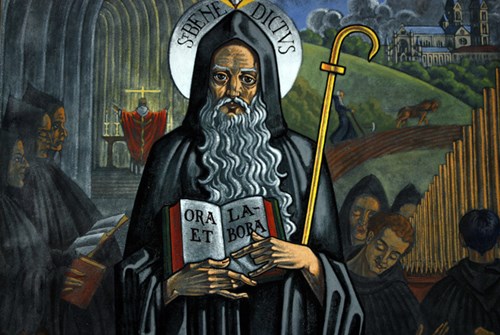
Today we celebrate St. Benedict’s passing (transitus) from death to eternal life. 


Benedict of Nursia compiled a rule for monks that has served as a guide for living the Gospel for more than 1500  years. Its down-to-earth, practical approach has proven effective not only for monks but for all who seek God in their daily lives. Here is a description of the Rule of St. Benedict from the website of Saint Meinrad Archabbey, St. Meinrad, IN.


The Rule of St. Benedict

st. benedict mural
Image of St. Benedict on a mural in Memorial Lobby
The Rule of St. Benedict was written as a guide to living life in community. It was not the first "rule" for Christian followers, but its common-sense approach and Scripture-based guidelines have stood the test of time.
Here are some comments about the Rule from Fr. Harry Hagan, OSB, a monk of Saint Meinrad Archabbey:

A Guide to Monastic Life

St. Benedict wrote his Rule roughly between 530 and 540 A.D. during the decline of the Roman Empire. Despite the chaos of the invading tribes, St. Benedict produced a classic statement on the monastic life.
By "classic," I mean a statement that transcends its historical situation. Though some of the guidelines belong only to its historical context, much in the Rule provides a vision that speaks not just to monastic life, but to life as a Christian and as a human being.
The Rule belongs generally to the wisdom tradition. This includes biblical wisdom such as the books of Proverbs, Ecclesiastes and Sirach. Wisdom literature balances opposing values.

An Example of Wisdom Literature

For example, "A stitch in time saves nine" is balanced by "Haste makes waste." The wise not only know both sayings, but they also know which one applies to the present situation--whether to act quickly or to move carefully and deliberately.
Wisdom is experiential knowledge that comes from living and not just studying. An understanding of the Rule comes not just from studying, but from living and being a part of a tradition.
Wisdom literature is wider than the Bible. Egypt had a number of "instructions," typically by a sage to his "son."
In similar fashion, St. Benedict opens his Rule by calling on the disciple to listen to the teacher, and so the Rule establishs the classic master-disciple relationship that can be found in many cultures. This relationship depends on the disciple entrusting himself or herself to the teacher in mutual trust and respect.

Tuesday, March 20, 2018

Critics of Pope Francis make me sad and angry. 


I don’t agree with everything the pope says or does. That’s not the point. Regardless of what we think about his surprising gestures or his attempts to unsettle us just when we’ve gotten comfortable with our lives, there is a reverence due to the Vicar of Christ that should cause us to stop and think.

Jesus was unconventional too. He disturbed the status quo. He challenged his disciples and the religious leaders of his day to look beyond their limited horizons in order to discover and do the Father’s will.

Is Pope Francis perfect? Not according to his own assessment of himself as “a sinner.” Is he a saint? Time and the grace of God will tell. Is he a heretic? Don’t be absurd. Does his teaching on morality need nuancing, even correction? Brighter minds than mine will have to examine and then speak to these issues, but from where I stand I think it’s pretty clear that Pope Francis is a man of the Church who is struggling to bring God’s love and mercy to all. Especially to those on the peripheries.

Pope Francis deserves our attention and our respect—both because of his position and because of what he has said and done during the past five years.